
Embedded Storage (eMMC/UFS) Capacity Upgrade Trends in AI Smartphones
The rise of AI smartphones is quietly transforming the requirements for embedded storage, pushing both capacity and performance far beyond what was typical just a few years ago. In devices where on‑device AI models, multimodal data, and continuous sensing are becoming standard, traditional eMMC and UFS configurations are no longer sufficient. Instead, we are seeing a clear trend toward larger capacities and faster UFS generations, with eMMC gradually retreating to entry‑level and non‑AI use cases.
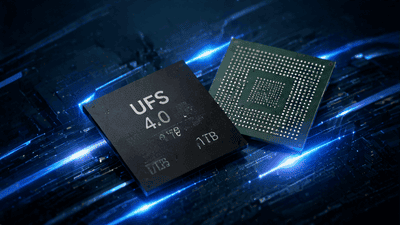
This blog post analyzes how embedded storage—specifically eMMC and UFS—is evolving in AI smartphones, the drivers behind capacity upgrades, and what these trends mean for smartphone makers, component suppliers, and users.
From basic apps to on‑device AI
Early smartphones primarily needed storage for the operating system, a modest set of apps, photos, and media files. In that environment, capacities like 32 GB or 64 GB and eMMC interfaces were often sufficient, especially in mid‑range and budget devices. Performance demands were moderate, and most computation relied on cloud services rather than heavy on‑device processing.
The emergence of AI smartphones changes this equation. Modern devices increasingly host large language models, multimodal inference engines, and edge AI workloads locally. These models require significant binary storage, while their associated data—embeddings, caches, user profiles, and multimodal content—adds further load. As a result, both minimum and typical storage capacities must rise to accommodate AI functionality without crowding out user data.
At the same time, higher I/O throughput is necessary to feed AI engines efficiently, favoring UFS over eMMC and driving adoption of newer UFS revisions in the AI era.
Capacity trends: from 64/128 GB to 256 GB and beyond
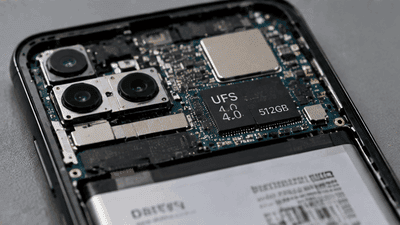
One of the most visible trends in AI smartphones is the upward shift in baseline storage configurations. Whereas 64 GB or 128 GB once served as common entry points for mid‑range devices, AI‑focused models increasingly start at 128 GB or 256 GB, with 512 GB and 1 TB options reserved for premium or heavy‑use scenarios.
This shift is driven by several factors. On‑device AI models and related assets can consume tens of gigabytes by themselves, including weights, tokenizers, and auxiliary data. Additional cache space is needed to support fast inference and personalization. At the same time, users continue to store high‑resolution photos, 4K/8K video, game assets, and offline media. OEMs recognize that shipping AI phones with low storage capacities risks user frustration and performance constraints.
Consequently, minimum capacity tiers are being raised and low‑capacity variants are being phased out, especially in mid‑range and flagship segments. Over a typical product cycle, this leads to a steady increase in average storage capacity per smartphone.
UFS ascendant, eMMC in retreat
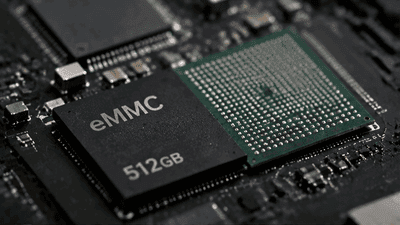
Alongside capacity growth, there is a clear interface transition in AI smartphones: UFS is increasingly dominant, while eMMC is being relegated to budget phones, wearables, and IoT devices. UFS offers much higher bandwidth and lower latency than eMMC, enabling faster app launches, quicker data access, and smoother AI operations.
For AI workloads that must move large model files and process multimodal data rapidly, UFS’s full‑duplex and high‑speed capabilities are critical. eMMC’s more limited throughput and half‑duplex nature make it a poor fit for flagship AI phones, though it remains adequate where cost and simplicity outweigh performance needs.
We therefore see OEMs increasingly specifying UFS for any device marketed with robust on‑device AI features, leaving eMMC to entry‑level or non‑AI‑centric segments. This trend is likely to continue as AI functionality becomes a baseline expectation in mainstream phones.
Generational upgrades: UFS 3.x to UFS 4.x and 5.x
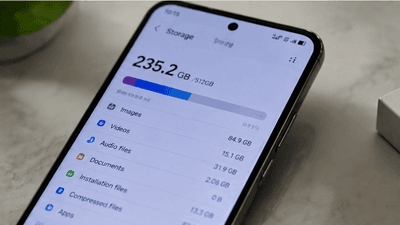
Within UFS, generational upgrades are closely tied to AI smartphone trends. Earlier UFS versions like 2.x and 3.x offered significant improvements over eMMC, but the latest generations deliver order‑of‑magnitude gains in sequential throughput and random I/O performance. These enhancements directly benefit AI tasks that involve loading large models and streaming high‑bandwidth data.
Newer UFS revisions are designed with on‑device AI in mind, offering high peak speeds while maintaining energy efficiency suitable for mobile form factors. As flagship AI phones roll out around 2025–2027, we can expect UFS 4.x and 5.x solutions to become standard in high‑end devices, especially those running large language models or multimodal AI locally.
The combination of greater capacity and faster interfaces allows AI smartphones to handle more ambitious workloads without unacceptable latency or battery impact, reinforcing the shift away from older storage standards.
AI workload characteristics and storage implications
AI workloads impose distinct demands on embedded storage. Large language models and multimodal networks often consist of many gigabytes of parameters, which must be stored locally if the device aims to perform inference without constant network access. Model updates, fine‑tuned variants, and personalization layers further add to the footprint.
Beyond model binaries, AI phones keep extensive logs, session histories, and user‑specific embeddings. Edge AI applications—such as intelligent photo enhancement, real‑time translation, and on‑device recommendation—may capture and store intermediary data as well, especially when implementing retrieval‑augmented approaches that maintain local databases.
All of this pushes storage requirements upward, both in capacity and in performance. Slow or small embedded storage becomes a bottleneck, limiting the practical size of models and the richness of their associated data. This is why capacity upgrades and UFS adoption are tightly linked to AI smartphone strategies.
Design decisions: minimum capacity and tiering
Smartphone OEMs face trade‑offs when deciding minimum capacities and storage tiers. Setting a low base capacity helps hit aggressive price points but risks constraining AI functionality and user experience. Raising the base to 256 GB or higher ensures room for AI models and user data but increases BOM costs.
In practice, many AI‑oriented devices are moving toward a tiered approach: a higher minimum capacity for AI‑flagship and premium models, with mid‑range devices offering AI features tuned to more modest storage configurations. Ultra‑budget phones may still use eMMC and smaller capacities, but typically with simplified AI functionality or reliance on cloud processing.
Over time, as on‑device AI becomes more central to the overall smartphone value proposition, we can expect minimum capacities to continue drifting upward, making 256 GB or more commonplace in mid‑range AI‑capable phones and higher tiers standard in flagships.
Impact on NAND and controller ecosystems
Capacity upgrades and UFS adoption have direct implications for NAND flash and controller ecosystems. Higher capacities mean more NAND dies per device, often using advanced 3D NAND with many layers and high bit‑per‑cell configurations. Controllers must handle increased parallelism, manage wear effectively, and deliver consistent performance under mixed AI workloads.
For UFS solutions, controller design becomes especially critical. AI smartphones demand low latency, high throughput, and robust error‑handling. Controllers must coordinate with host SoCs, power management strategies, and thermal constraints to maintain performance without excessive battery drain or throttling.
These requirements encourage close collaboration between NAND vendors, controller designers, and smartphone OEMs. As AI demands grow, storage vendors that can offer integrated, optimized UFS solutions with strong firmware support are well positioned to capture design wins in high‑end AI phones.
Battery life, thermals, and storage efficiency
Storage capacity and performance upgrades must be balanced against battery life and thermal considerations. High‑throughput UFS can consume significant power under sustained load, especially when moving large AI models or multimodal data. AI smartphones must therefore optimize how often and how intensively they access storage.
Techniques such as intelligent caching, compression, and data lifecycle management help reduce unnecessary I/O, improving efficiency. Some AI frameworks may keep frequently used portions of models in RAM or specialized memory, minimizing repeated reads from storage. Others may dynamically adjust storage usage based on power and thermal conditions.
Embedded storage efficiency—both at the hardware and firmware levels—thus becomes a key differentiator in AI smartphones, influencing user‑perceived performance and battery satisfaction even as capacities and speeds rise.
Market segmentation: AI flagships vs mainstream devices
AI smartphones are not a monolithic category. Flagship AI devices, which aim to run large models and complex multimodal inference locally, typically adopt the highest capacities and fastest UFS versions. Mainstream phones may include lighter AI features, relying on smaller models, more cloud integration, or selective on‑device computation.
As a result, storage trends vary by segment. Flagships move aggressively toward 512 GB and 1 TB UFS configurations, while mid‑range AI phones settle around 256 GB or 128 GB with UFS 3.x or 4.x. Entry‑level phones still often use eMMC and smaller capacities, focusing on basic AI helpers and cloud‑centric services.
This segmentation allows OEMs to balance cost and capability, but it also raises user expectations: as AI experiences spread, even mainstream devices will eventually need more storage and performance to avoid perceivable gaps with flagship behavior.
Consumer experience: why capacity upgrades matter
From the user’s perspective, capacity upgrades in AI smartphones translate into tangible benefits. Devices with ample storage can host richer AI features without forcing trade‑offs in media or app installations. Users are less likely to run into “storage full” warnings when installing AI‑heavy applications or downloading offline content.
Higher‑capacity and UFS‑based storage also improves day‑to‑day responsiveness. AI features that depend on fast access to models and data feel smoother, with fewer delays when invoking assistants, processing images, or running local inference. These qualitative improvements reinforce the perceived value of AI capabilities and justify buyers’ willingness to pay for larger capacities.
Over time, capacity upgrades become part of the baseline expectation for new phones, much as RAM increases did in earlier eras. Users come to see large storage as necessary for AI and media‑rich lifestyles rather than as a luxury add‑on.
Future directions: beyond capacity to new storage roles
Looking ahead, embedded storage in AI smartphones may evolve beyond simple capacity and performance metrics. As on‑device AI matures, storage could take on roles in secure model hosting, encrypted personal data vaults, and specialized retrieval‑augmented structures that blur the line between storage and knowledge bases.
New interfaces and standards may emerge to optimize data flows between storage, RAM, and AI accelerators, further integrating storage into the AI pipeline. Persistent memory technologies and tighter coupling of storage with compute may also play roles, especially in high‑end devices.
In this context, today’s capacity upgrade trends are a foundation for future innovation. Ensuring ample, fast storage in AI smartphones is the prerequisite for more advanced, personalized, and privacy‑preserving AI experiences that will depend heavily on local data and models.
Conclusion: embedded storage as a cornerstone of AI phones
The capacity upgrade trends in embedded storage (eMMC/UFS) reflect the broader transformation of smartphones into AI devices. As on‑device AI becomes a central feature rather than a novelty, storage must scale in both size and speed to keep pace with model growth, data richness, and user expectations.
With eMMC gradually retreating to lower tiers and UFS—especially its latest generations—taking center stage, AI smartphones are setting a new baseline for embedded storage. Stakeholders across the ecosystem, from NAND and controller vendors to OEMs and software developers, will need to align their strategies with this reality to deliver devices that fully realize the promise of AI in the palm of the user’s hand.