
NAND Makers Shift from Production Cuts to QLC/PLC Capacity Allocation
After several years of responding to weak pricing and oversupply with production cuts, NAND flash manufacturers are pivoting to a different playbook. Instead of simply dialing back wafer input, they are reallocating capacity toward higher‑density technologies such as QLC (quad‑level cell) and PLC (penta‑level cell). This strategic shift reflects a maturing market in which the main lever is no longer how many bits to produce, but what kind of bits to make and for which segments.

This blog post explores why NAND makers are moving from production cuts to QLC/PLC capacity allocation, how this transition changes the economics of the industry, and what it means for SSD vendors, data center operators, and consumers. We will look at the background of previous downcycles, the technical and economic logic behind QLC/PLC, the risks and trade‑offs of higher bit‑per‑cell designs, and the practical implications across different storage markets.
From blunt production cuts to finer capacity tuning
In past downturns, NAND makers relied heavily on production cuts to stabilize prices. When demand softened or capacity overshot, they reduced wafer input, delayed new fabs, and stretched technology transitions. These measures helped draw down inventory and put a floor under collapsing ASPs, but they were blunt instruments: they affected all product types more or less equally, regardless of their strategic value.
As the NAND industry has matured, manufacturers have become more nuanced in their responses. They recognize that not all bits are equal. Bits destined for high‑value enterprise SSDs or premium client drives generate more revenue and margin than bits shipped into highly price‑sensitive markets. Simply cutting production across the board can protect pricing but may also starve profitable segments and slow the adoption of new technologies.
Shifting toward capacity allocation—deciding how much of total output will be TLC, QLC, PLC, and at which process generations—allows vendors to manage supply at a more granular level. Rather than only shrinking total volume, they re‑shape the product mix to emphasize designs that maximize economic return and align with long‑term market trends.
QLC and PLC: more bits per cell, new economics
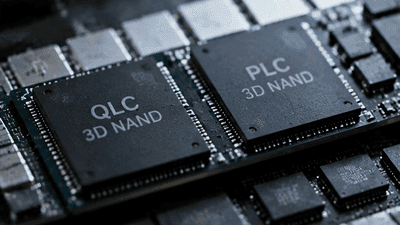
QLC and PLC are higher‑density NAND technologies that store more bits per memory cell than traditional TLC (triple‑level cell). QLC stores four bits per cell, while PLC stores five. By increasing bits per cell, vendors can produce more logical capacity from a given physical silicon area, reducing cost per bit over time once yields and reliability are under control.
This density advantage is especially attractive in markets where cost per gigabyte is paramount, such as mass‑market SSDs, nearline storage, and certain cloud tiers. For manufacturers, allocating capacity to QLC and PLC promises higher output of sellable capacity per wafer, improving capital efficiency. Instead of cutting production to defend prices, they can transition more of their output to higher‑density formats, reducing unit cost while targeting segments that tolerate or even welcome these technologies.
However, QLC and PLC also introduce challenges. As more bits are stored per cell, error margins shrink, endurance drops, and managing read and write characteristics becomes more complex. The economics of QLC/PLC depend on successfully mitigating these issues through controller design, firmware algorithms, error‑correction coding, and clever workload placement. Capacity allocation thus becomes an exercise in matching technology characteristics to appropriate use cases rather than indiscriminately pushing density everywhere.
Why now: structural demand and technology maturity
NAND makers are shifting strategies now because the industry environment has changed. On the demand side, structural growth in data and storage needs persists, driven by cloud computing, AI workloads, streaming, and digital transformation across sectors. While cyclical fluctuations still occur, the long‑term trajectory is upward. Vendors see room to expand capacity but want to do so in a way that protects margins.
On the technology side, QLC has moved past its early stages. Vendors have shipped multiple generations of QLC‑based products, refined controllers and firmware, and built experience with endurance and reliability in real deployments. PLC, while newer, benefits from lessons learned with QLC and the steady progress of 3D NAND architectures. As these technologies mature, confidence grows that they can serve more than just niche or experimental roles.
Combining structural demand with maturing high‑density technologies makes capacity allocation a more attractive lever than broad production cuts. Rather than constraining growth, vendors aim to steer it toward product types that balance cost, performance, and reliability in ways that preserve profitability.
Segmenting the market: where QLC and PLC fit

Allocating capacity to QLC and PLC is not a one‑size‑fits‑all decision. NAND makers must segment the market and identify where these technologies add the most value. Typically, the best fits are workloads with heavy read bias, predictable access patterns, and tolerance for moderate latency and write endurance.
For example, QLC is well suited for read‑centric cloud storage tiers, backup repositories, content delivery caches, and archive layers that still benefit from SSD performance over HDDs but do not require the full endurance of TLC. In these cases, using QLC allows providers to offer SSD‑based services at more attractive price points while still delivering improved performance and reliability compared with spinning disks.
PLC is an emerging candidate for even denser, cost‑optimized tiers, potentially serving long‑term storage or secondary data layers where writes are infrequent and performance requirements are moderate. Because PLC pushes endurance and error rates closer to the edge, it may be introduced slowly, with careful workload matching and conservative design margins.
Implications for TLC and high‑performance tiers
As vendors allocate more capacity to QLC and PLC, they must also decide how much to maintain in TLC and other lower‑bit‑per‑cell formats. TLC remains the mainstay for performance‑sensitive SSDs, including many enterprise and prosumer drives, because it offers a better balance between endurance, latency, and cost.
Capacity allocation does not mean abandoning TLC; instead, it means reserving TLC output for segments where its advantages are essential. High‑end enterprise SSDs, write‑intensive workloads, and premium client devices are likely to continue relying heavily on TLC. NAND makers may deliberately limit TLC capacity to avoid oversupplying these segments and eroding margins, while allowing QLC and PLC to absorb growth in more cost‑sensitive or read‑heavy tiers.
This differentiation reinforces product tiering: TLC for performance and endurance, QLC for mainstream capacity, and PLC for ultra‑dense, specialized tiers. Customers and SSD vendors must adjust expectations accordingly and ensure that their product lines clearly communicate these trade‑offs.
SSD vendor strategies: controllers, firmware, and tiering

SSD vendors, whether vertically integrated or fabless, play a critical role in making QLC and PLC successful. The shift in NAND makers’ capacity allocation pushes SSD designers to invest more heavily in controllers and firmware optimized for high‑density cells. Error‑correction algorithms, wear‑leveling strategies, and caching mechanisms become more sophisticated to maintain acceptable performance and endurance.
For QLC drives, SSD vendors often use large SLC caches, advanced LDPC error correction, and intelligent data placement to shield end‑users from the raw characteristics of QLC cells. They align write‑intensive workloads with cache behavior, flush data to QLC in ways that minimize wear, and prioritize read performance where it matters most. PLC will require even more careful management, likely relying on larger caches and more constrained write patterns.
At the product level, SSD vendors are expanding tiered offerings: TLC‑based enterprise drives at the high end, QLC‑based high‑capacity drives for mainstream and cloud, and experimental or niche PLC products for ultra‑dense storage. Clear tiering helps customers choose appropriate drives for their workloads and makes the economics of capacity allocation visible and understandable.
Data center and cloud operator perspective
For data center and cloud operators, the shift toward QLC and PLC capacity allocation translates into more nuanced storage tier choices. Rather than deciding simply between HDD and SSD, they increasingly select among different SSD types with varying performance, endurance, and cost characteristics. This opens opportunities for more granular service offerings but also demands careful architecture and planning.
Operators can use QLC‑based SSDs to create affordable, high‑capacity tiers that still outperform HDDs for many workloads. These tiers might host user content, logs, backups, or AI training datasets that are heavily read but less frequently updated. TLC-based SSDs remain the standard for transactional databases, hot analytics, and write‑intensive AI workloads. PLC, when it becomes more widely available, could underpin massive archival layers or long‑term storage pools that still benefit from flash reliability and access patterns.
Capacity allocation decisions made by NAND makers influence pricing and availability of these tiers. Data center architects must track how QLC and PLC offerings evolve and adjust their designs to take advantage of new price–performance points without over‑relying on technologies that may not yet be mature for certain workloads.
Consumer markets: more affordable SSDs, new trade‑offs
In consumer markets, QLC and eventually PLC capacity allocation promise more affordable SSDs with larger capacities. Users benefit from the ability to purchase higher‑capacity drives for gaming, content creation, and general computing without paying a steep premium for TLC‑based products. As QLC production increases, mainstream SSD prices can decline for a given capacity, accelerating the shift away from HDDs in personal devices.
However, consumers must be aware of trade‑offs. QLC‑based consumer SSDs may exhibit lower endurance and different performance profiles under heavy write loads compared with TLC drives. For typical usage patterns—mostly reads, occasional writes—the differences may be negligible, but power users who perform frequent large writes, such as video editors, may still prefer TLC products.
NAND makers and SSD brands bear responsibility for clear messaging about product characteristics. As capacity allocation changes, marketing should avoid oversimplifying differences between QLC and TLC drives. Honest communication about intended use cases and endurance helps consumers make informed choices and reduces the risk of disappointment or misuse.
Risk management: endurance, reliability, and perception
One of the main risks in shifting capacity toward QLC and PLC is perception. Early reports of QLC endurance concerns and performance drops under certain conditions shaped skepticism among some users and developers. Even as technology improves, overcoming these perceptions requires consistent real‑world reliability and transparent data.
NAND makers and SSD vendors must invest in validation, publish endurance ratings, and support long‑term deployments to demonstrate that QLC and PLC can meet expectations within their intended roles. Rushing immature PLC products into mission‑critical environments would be counterproductive, reinforcing doubts. Instead, gradual, evidence‑based expansion of QLC and PLC deployments will solidify confidence.
At a technical level, risk management involves designing robust guardrails in controllers and firmware: tight wear‑leveling, conservative write amplification targets, and proactive health monitoring. Enterprise deployments may also use redundancy and error recovery schemes at system level to hedge against device‑level risks. These measures help ensure that capacity allocation decisions do not undermine overall reliability and trust.
Long‑term outlook: a multi‑tier NAND ecosystem
Looking ahead, the shift from production cuts to QLC/PLC capacity allocation signals a maturation of the NAND ecosystem into a multi‑tier structure. Instead of one dominant cell type serving all markets, different cell formats and process generations coexist, each aligned to specific performance and cost requirements. Vendors orchestrate this diversity through capacity planning, product roadmaps, and customer guidance.
As QLC and PLC become more established, capacity allocation will likely be refined further. Manufacturers may adjust proportions dynamically based on demand signals from cloud providers, OEMs, and consumer markets. This flexibility can dampen extreme price swings and allow the industry to respond more gracefully to shifts in workload patterns and economic conditions.
For stakeholders across the storage stack, understanding this multi‑tier future is crucial. Data centers, SSD vendors, and end users will all need to map workloads to suitable flash tiers, accept that “SSD” no longer implies a single performance profile, and appreciate how underlying NAND capacity allocation shapes prices and capabilities.
Conclusion: capacity allocation as the new lever
NAND makers’ move from broad production cuts to strategic QLC/PLC capacity allocation marks an important transition in how the industry manages cycles and growth. By focusing on what type of capacity to produce rather than only how much, vendors aim to align technology, demand, and profitability in more sophisticated ways.
Higher‑density cell technologies like QLC and PLC open new opportunities for affordable, high‑capacity SSDs across cloud, enterprise, and consumer markets. At the same time, they demand careful workload matching, robust controller and firmware design, and transparent communication about trade‑offs. As this shift progresses, the NAND ecosystem will become more layered, with multiple flash types coexisting and serving different roles.
For buyers and integrators, the key is to engage with this emerging structure: recognize where QLC and PLC fit, monitor how vendors allocate capacity over time, and design systems that leverage high‑density flash without compromising reliability or performance. In doing so, they can benefit from the new economics of NAND while navigating the complexities of a more diverse and dynamic storage landscape.