
Memory Sector Beta vs. Individual Alpha: Passive Allocation or Active Stock Picking?
The global memory industry has moved from a quiet, cyclical corner of semiconductors to the center of attention thanks to AI, cloud computing, and high‑performance hardware. For investors, this shift raises a pressing question: is it enough to capture “sector beta” by owning broad exposure to memory, or does the complexity and dispersion within the industry justify an “individual alpha” approach focused on active stock picking? Put differently, should you treat memory like an index trade or like a hunting ground for idiosyncratic winners?

This blog post explores the trade‑off between memory sector beta and individual alpha. We define what those terms mean in the context of DRAM, NAND, and adjacent segments; examine how industry structure and cycles influence passive vs. active strategies; and outline practical frameworks for deciding when and how to lean into sector‑wide exposure or targeted stock selection.
Defining sector beta and individual alpha in memory
In investment jargon, “beta” refers to exposure to systematic risk and return—how much a position moves with a broader market or sector. “Sector beta” in memory means owning diversified exposure to memory as a whole, typically via baskets of major DRAM and NAND producers, module makers, and related plays. Your goal is to ride the overall memory cycle rather than to pick specific winners and losers.
“Alpha,” by contrast, is excess return relative to a benchmark, driven by idiosyncratic insights or skill. “Individual alpha” in the memory sector means identifying particular companies whose earnings, technology positioning, or capital allocation strategies will outperform the average memory name. It requires deeper analysis of business models, competitive dynamics, and valuation.
In practice, the choice is not binary. Many investors hold a core sector‑beta allocation to memory and overlay selective active positions aimed at generating alpha. Understanding when beta dominates and when alpha opportunities are most promising is the key to constructing a robust strategy.
The case for memory sector beta: riding the cycle

The simplest argument for sector beta in memory is that the industry remains highly cyclical and concentrated. Major DRAM and NAND producers tend to move together when supply–demand balances tighten or loosen. In upcycles, rising average selling prices (ASPs) and improving margins lift most boats; in downcycles, oversupply and price pressure drag the group lower.
For investors who do not want to forecast granular company‑specific outcomes, owning a diversified basket of memory names can be an efficient way to express a macro view: bullish on AI and data‑center deployment, or cautious about global demand and capex. Sector beta captures broad trends such as the transition to DDR5, expansion of HBM capacity, and rising SSD penetration, without requiring precise stock selection.
Beta exposure also benefits from simplicity. You can focus on timing entry and exit around cycles—accumulating exposure when valuations reflect pessimism and trimming when optimism and margins peak—rather than debating which management team will execute best. This approach emphasizes cycle timing and risk management over company‑specific research.
Why individual alpha exists in a cyclical sector
Despite the strong common dynamics, memory is not a monolith. Within DRAM, NAND, and related segments, companies differ in technology leadership, product mix, customer concentration, balance sheet strength, and capital discipline. These differences create persistent dispersion in earnings quality and long‑term value creation, which is the raw material for individual alpha.
For example, one manufacturer might be early and aggressive in HBM investments, capturing disproportionate share of AI‑driven growth, while another remains more reliant on commodity DRAM or low‑end NAND. Some companies maintain strict capital discipline, avoiding over‑expansion and preserving margins; others chase volume and suffer more in downturns. Management quality, IP position, and regional policy support can all tilt outcomes.
Active investors who can distinguish between structurally advantaged and structurally challenged names—rather than treating all memory stocks as interchangeable—have a chance to generate alpha by overweighting the former and underweighting or avoiding the latter. The sector’s cyclicality becomes an opportunity: cycles amplify both good and bad positioning, increasing return dispersion across names.
Structural trends increasing dispersion
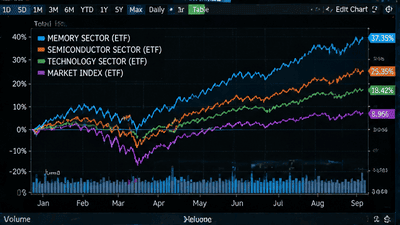
Recent structural trends in computing have increased the potential for alpha within the memory space. AI and accelerator‑centric architectures have elevated HBM and high‑performance DRAM to strategic significance. The rise of enterprise SSDs, QLC/PLC adoption, and CXL‑linked memory expansion has created new niches and sub‑segments where certain companies can differentiate.
As memory use cases diversify—smartphones, PCs, servers, edge devices, automotive, and AI infrastructure—companies with strong exposure to fast‑growing or high‑margin niches may diverge significantly from peers focused on slower or more commoditized segments. For instance, a vendor deeply entrenched in enterprise SSDs and HBM might experience different earnings trajectories than one concentrated in low‑end consumer NAND or legacy interfaces.
These structural shifts reduce the degree to which “all memory is the same.” They create contexts where active stock picking, grounded in understanding product roadmaps and customer relationships, can identify companies whose earnings power is mispriced relative to the sector average.
Risk profiles: beta volatility vs. alpha uncertainty
Choosing between sector beta and individual alpha also involves weighing different risk profiles. Sector beta exposure to memory tends to be highly volatile, reflecting the industry’s sensitivity to macro conditions, capex cycles, and technology transitions. However, this volatility is relatively transparent: you know you are exposed to the cycle as a whole, and you can manage position size and timing accordingly.
Individual alpha strategies introduce idiosyncratic risk. A company that appears well positioned may face unexpected execution challenges, legal issues, or competitive shocks. Technology bets—such as moving aggressively into QLC, PLC, or novel packaging—can pay off or backfire. Active stock picking demands confidence not only in the industry cycle but in each firm’s ability to navigate it.
Investors uncomfortable with company‑specific uncertainties may prefer beta exposure, accepting cyclical volatility while avoiding concentration on any single management team. Those willing to research deeply and monitor developments closely can embrace alpha opportunities, knowing that the potential for outperformance comes with higher idiosyncratic risk.
Passive allocation: advantages and limitations

Passive allocation to memory sector beta—via diversified baskets or indices—offers several advantages. It is time‑efficient, reducing the need for intensive stock‑level analysis. It minimizes single‑stock risk by spreading exposure across multiple names. It aligns with the view that, over time, major memory players will collectively benefit from secular growth in data, AI, and solid‑state storage, even if cycles produce ups and downs.
However, passive allocation also has limitations. It treats companies with different strategies and prospects as equally deserving of capital. If some memory names systematically underperform due to weak governance or poor capital discipline, a pure beta approach locks in that drag. Passive exposure may also be too coarse to exploit specific secular themes—such as HBM, enterprise SSDs, or CXL‑linked memory expansion—that play out unevenly across the sector.
In addition, passive approaches can miss opportunities to reduce downside in cycles. An investor who understands which companies are most vulnerable to price collapses or oversupply may prefer to underweight or avoid them, while still keeping sector exposure via stronger names—something a pure beta strategy does not permit.
Active stock picking: where it adds the most value
Active stock picking in memory adds the most value when dispersion in fundamentals and valuations is high and when specific secular themes create identifiable winners. Situations where one company has clear technology leadership, superior cost structure, or unique customer relationships lend themselves to alpha‑oriented strategies.
For example, if a memory vendor leads in HBM production and has deep partnerships with major AI accelerators, its earnings may be more resilient and levered to AI growth than peers with limited HBM exposure. Similarly, a company that has built a strong presence in enterprise NVMe SSDs and data‑center storage could benefit from multi‑year secular cycles even when commodity NAND prices fluctuate.
Active stock pickers can target such names, building conviction around their long‑term advantages and using cyclical downturns as opportunities to accumulate positions at attractive valuations. Conversely, they can avoid or underweight companies that appear stuck in structurally weaker segments, have inconsistent capital allocation, or lag in key technologies.
Combining beta and alpha: a barbell approach
In practice, many investors blend sector beta and individual alpha in a barbell strategy. On one side, they hold a diversified memory basket or core holdings in major DRAM and NAND producers to ensure participation in broad sector moves. On the other, they allocate a portion of capital to high‑conviction individual names linked to specific themes, intending to generate alpha on top of the beta backdrop.
This approach recognizes that timing the memory cycle is difficult, and that being entirely out of the sector when it turns up can mean missing significant gains. A core beta allocation keeps you in the game. Meanwhile, selective alpha positions allow you to overweight companies that you believe will outperform on fundamentals, creating potential for excess return.
The barbell strategy also helps manage risk: core holdings absorb some volatility and provide diversification, while alpha positions are sized according to conviction and risk tolerance. It encourages continuous research and refinement without forcing every decision to be an all‑or‑nothing bet on a single stock or the entire sector.
Practical frameworks for decision‑making
To decide between passive allocation and active stock picking—or to design a hybrid—the following practical frameworks can help:
First, assess your expertise and resource commitment. If you have limited time or familiarity with semiconductor and memory industry details, prioritizing sector beta via diversified exposure may make sense. If you are willing and able to follow company‑specific developments, earnings calls, and technology roadmaps, you can justify a more alpha‑oriented approach.
Second, evaluate current market conditions. When valuations across the sector are uniformly depressed due to a broad downcycle, a beta entry may be attractive: the risk–reward from simply owning the group can be compelling, and company‑specific differentiation may matter less in the early recovery phase. Later in the cycle, when dispersion in performance and valuation widens, alpha strategies may deliver more incremental value.
Third, map secular themes to specific companies. Identify which names are most exposed to AI‑driven HBM demand, enterprise SSD growth, new memory standards such as DDR5, or emerging technologies like CXL. If you can clearly connect themes to companies with strong positions and reasonable valuations, alpha opportunities are more tangible.
Finally, define risk limits and diversification rules. Decide what portion of your portfolio you are comfortable allocating to memory overall, and within that, what share to dedicate to broad beta vs. concentrated alpha positions. This prevents over‑exposure and keeps strategy aligned with your risk tolerance.
Common pitfalls in memory investing
Regardless of whether you pursue beta or alpha, several pitfalls are common in memory investing. One is ignoring cyclicality. Even strong companies face margins compressing when supply exceeds demand. Assuming straight‑line growth can lead to overconfidence and poor timing.
Another pitfall is conflating technology headlines with durable earnings power. A company may showcase impressive technical demos or early‑stage partnerships without translating them into sustained revenue and margin improvements. Alpha strategies must distinguish between marketing and executed, profitable deployment.
A third pitfall is over‑concentration. Memory cycles can be sharp, and single‑stock blow‑ups can occur due to unexpected issues. Maintaining diversification and sizing positions appropriately helps mitigate these risks, whether you aim for beta, alpha, or both.
Finally, short‑term trading on noisy data points—weekly spot price moves, rumor‑driven news—can distract from the core drivers: capacity decisions, secular demand trends, and long‑term technology positioning. Investors should anchor decisions in fundamentals, using short‑term signals as context rather than primary drivers.
Conclusion: choosing your path in memory investing
The tension between memory sector beta and individual alpha captures a broader choice in semiconductor investing: treat the industry as a macro cycle to ride, or as a complex ecosystem where specific companies can be sustainably advantaged. In reality, the best strategies often blend both perspectives, using broad exposure to capture cyclical upside while selectively backing names with differentiated, well‑researched strengths.
By understanding how DRAM, NAND, and adjacent memory segments respond to global demand, technological change, and capital discipline, investors can decide when passive allocation suffices and when active stock picking is warranted. Memory’s volatility and structural evolution make it a challenging but fertile field for thoughtful investors—whether they seek sector‑wide beta, individual alpha, or a calibrated mix of the two.